Trails in the Great Smoky Mountains.

Release of the Great Smoky Mountains Trail Atlas

Friday, July 4th, 2008

On July 4th we released a trail lover’s and backpacker’s atlas for a wild & historic national treasure, the Great Smoky Mountains National Park. Our trail atlas was designed for the modern trail user equipped with a GPS, but we focus our cartography on showing the rugged, historical, and ecological character of the park. These maps are beautiful, easy to read, and provide a pleasure as you wander over the pages and discover a new Smokies.

(more…)

Trout Fishing in The Great Smokies

Monday, May 5th, 2008

TroutOne cannot fully appreciate the Smokies without fly fishing its abundant streams. From high mountains reaches to larger rivers at lower elevations, the park has nearly a thousand miles of fishable waters. The best experiences require hiking into remote portions of the park and finding clean, cold pools near fast moving rapids.

The brook trout are the only native species of game fish found here and are also known as “spec” or “speckled trout” by older locals. These native trout depend on clear and cold water to thrive and, where found, indicate a healthy, unmolested mountain stream. Although the history of logging and air pollution in the park have threatened brook trout populations, the park’s conservation effort has made the Great Smokies one of last great wild habitats for native fish in the eastern U.S.

Rainbow trout are the prized game fish in the park and are generally 6-10 inches in length. These fish were introduced here by logging camps in the early 1900s. Brown trout were imported from Europe and can reach over 2 feet in length, weigh 10 pounds, and live a dozen years. Brook trout live fewer than 3 years and rarely exceed 9 inches. Smallmouth and rock bass, both non-native, inhabit the lower rivers and streams along the park’s boundary.

FishingThe Park’s Aquatic World

Most of the park’s larger streams begin as springs along the Appalachian Trail high on the crest of the Smokies. As these small streams travel down the mountainside, they are joined by others to form progressively larger waterways. As this happens, the streams change from steep, shady, rushing cascades, dotted with beautiful waterfalls at high elevations, to wider, slower-moving waterways with gentle gradients at lower elevations. The forest canopy no longer completely covers lower elevation streams.

(more…)

Historical & 3D Maps of the Great Smokies

Sunday, January 27th, 2008

Historical MapWe’re continually updating the Great Smoky Mountains National Park Trail Atlas and hope to have a pre-release sample here by early March. The emphasis now is cleaning the labels on the 1:90k map series. These two maps here are sections in the atlas and we appreciate any feedback or comments. Each link takes you to a zoomable and pannable image of the map.

The map on the left is the Pioneer Places of the Great Smoky Mountains, a 1926 U.S Geological Survey map overlaid with modern-day park destinations. The map shows the park on the eve of its creation. The cartography is exceptional and has been preserved where possible. Many of the park place names have changed over the century with the addition of many dedicated names after the park’s creation. In some cases names were moved to accommodate significant persons deemed more worthy of a place name than the existing title.

3D Map of the Great Smokies
The map on the right is a Bird’s Eye View of the Great Smoky Mountains. This 3rd draft 3D map shows the major landforms in Smokies and helps the hiker understand the topography and major drainages in the park. Each feature has an elevation (in feet above sea level) tagged in its label. The Appalachian Trail is signified by the yellow line. This major revision pushes the colors to purer CMYK mixes that make it less muddy in process-color printing.

Waypoints in the Great Smoky Mountains

Sunday, January 20th, 2008

Manual CoverHiker Great Smoky Mountains GPS Data Pack
Waypoints & track GPX data for trails, trail intersections, backcountry camps, summits, gaps, and many other locations for backcountry navigation.
Download: 36 megabyte
Format: GPX & PDF
Pieces: Map Guide, GPS Manual, Gazetteer, Data
Ownership: Great Smoky Mountains National Park, NPS

Great Smoky Mountains GPS Data Pack: $6

Our data pack contains 16 GPX files, companion gazetteer, and historic topographic map with 1-minute GPS grid. The product is offered only as a 36 megabyte download, which includes all documentation, maps, and data. Buyers have free access to new releases and updates.
(more…)

Great Smoky Mountains Weather Station

Sunday, December 16th, 2007

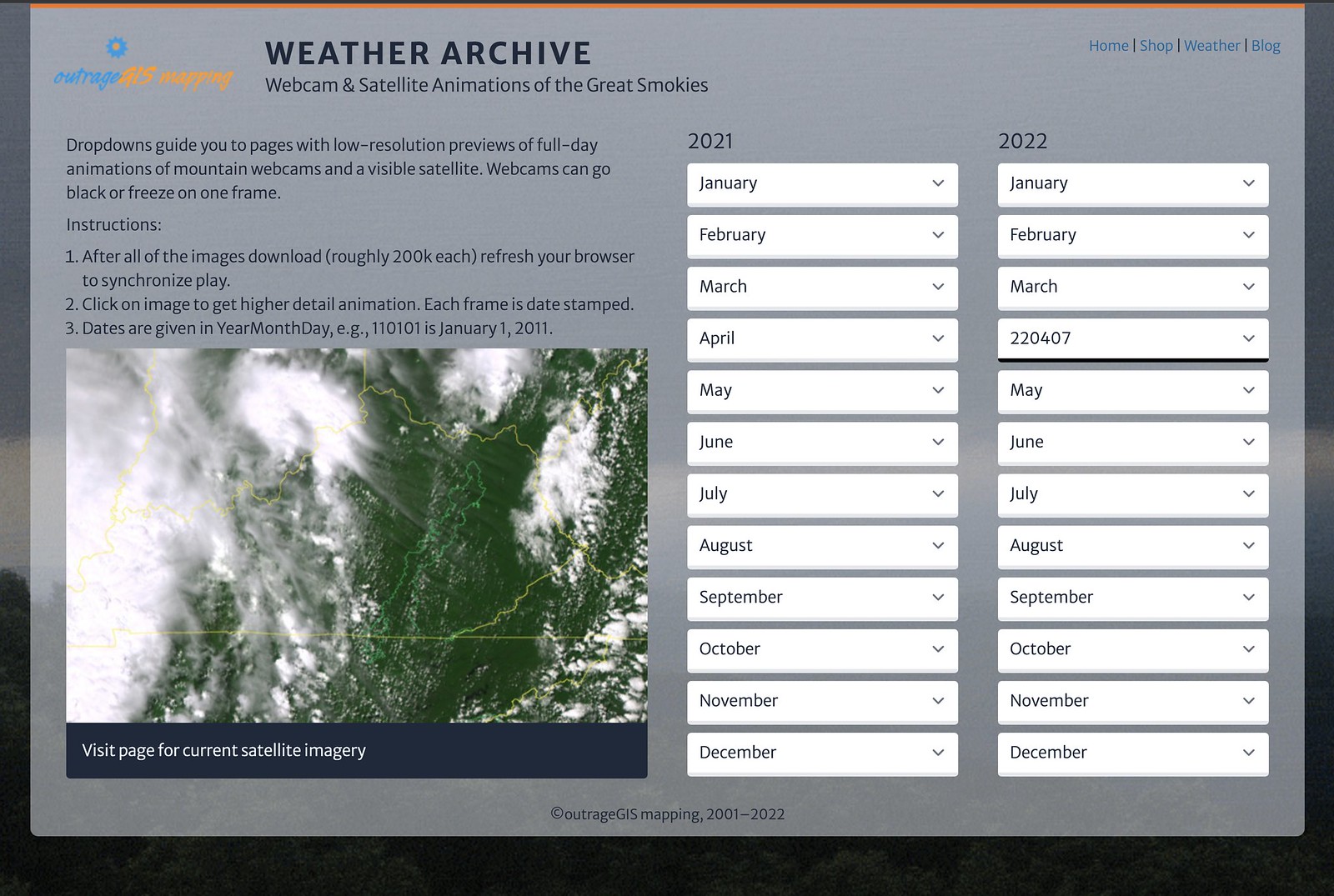
WeatherWe introduce our new weather page for the Great Smoky Mountains National Park.

This site aggregates the best weather data and maps for the national park and surrounding mountain area. Maps are from the National Weather Service (NWS) and composited with the national park boundary for easy location. The data is fed from real-time NWS observations and watches, warnings, & advisories.

We think this is the best page for your weather needs if you plan to visit the smokies or long to be there now. For example, the map at left shows the visible satellite of the region centered on the park, shown in the yellow polygon. Cloud cover is good to consider for photographic trips. If the map is dark, well…you’ll need a flash or long exposure.

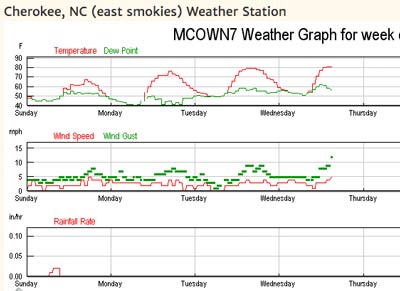
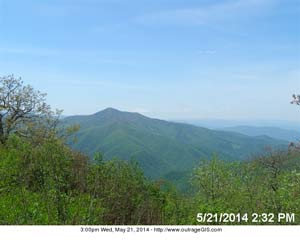
Other weather information and tidbits we include are links to the official NWS forecast page, which is an excellent site, and webcams for Look Rock and Purchase Knob. We have a link to the high & low temperatures, precipitation, and snow depth for the Sugarland Center, Newfound Gap, Cades Cove, Oconaluftee, & Mt. LeConte.

You can visit the page here: http://www.outrageGIS.com/weather/grsm. We also constructed a page that has current radar, visible satellite, and weather statements here.